





The roulette wheel has been spinning for centuries, and with the explosion of online casinos, it has never been more accessible — or more prone to manipulation. The hard truth is that not every roulette game you encounter online is running fairly. Some platforms cut corners, use uncertified software, or operate without proper oversight, leaving players at the mercy of systems designed against them.
Whether you’re just getting started or you’ve been playing for years, knowing how to spot a fair roulette game is one of the most valuable skills you can have as a player. It protects your money, your time, and your trust. In this guide, we break down exactly what to look for — step by step — so you can play with confidence and never have to guess whether the wheel is truly random.
Trusted Casinos Offering Fair Roulette Games

Bonus up to
$3,500 + 200 FS

Bonus up to
$5,000

No Welcome Bonus

Bonus up to
$2,200
Step 1: Verify the Casino License
Before you look at a single game, the first thing any smart player should do is check the casino’s license. A gambling license is not just a formality — it is the foundation of everything. Licensed casinos are held to strict standards, regularly audited, and legally required to offer fair gameplay. Without one, there is no accountability.
What are gambling regulatory bodies and why do they matter?
Regulatory authorities are independent organizations that issue licenses to online casinos and enforce the rules those casinos must follow. Some of the most respected names in the industry include:
- Malta Gaming Authority (MGA) — one of the most rigorous and widely recognized regulators globally
- UK Gambling Commission (UKGC) — known for extremely strict player protection standards
- Gibraltar Regulatory Authority — long-standing authority trusted by major operators
- Curaçao eGaming — common among international casinos, though considered less strict than the above
- Isle of Man Gambling Supervision Commission — respected for its thorough oversight
Each of these bodies requires casinos to use certified software, maintain fair payout rates, and protect player funds. If a casino is caught rigging games or failing to pay players, it risks losing its license — which is a significant deterrent.
How to verify a casino’s license in practice
Scroll to the very bottom of the casino’s website — the footer. Every licensed casino is required to display its licensing information there. You should see the logo or name of the regulatory authority along with a license number.
Here is the key step most players skip: click on that logo or license badge. A legitimate license badge is always clickable and will redirect you to the official website of the licensing authority, where you can verify that the license is active, valid, and issued to the casino you are visiting. If the badge is not clickable, leads to a dead link, or redirects you anywhere other than an official regulatory website — treat that as a serious red flag.
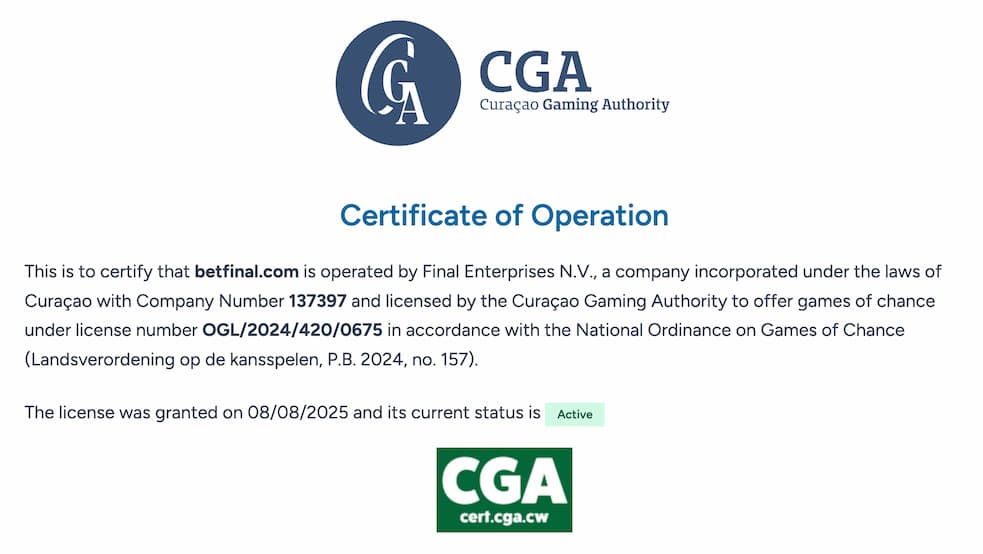
A casino operating without a proper license, or with a fake one, has zero obligation to run fair games. The license is your first and most important layer of protection.
Step 2: RNG Certifications: How Digital Roulette Proves Fairness
In standard online roulette — the kind you play against software rather than a live dealer — every spin outcome is determined by a Random Number Generator, or RNG. This is the algorithm that replicates the randomness of a physical roulette wheel spinning in a real casino. Because you cannot see the wheel, you are trusting entirely that this software is doing what it claims.
The question is: how do you know the RNG is actually random?
You don’t — unless it has been independently tested. And that is exactly what legitimate casinos are required to do.
How RNG certification works
Regulatory bodies do not simply take a casino’s word for it that their RNG is fair. When a casino applies for or renews a license, it is required to submit its RNG software for testing by an approved third-party laboratory. These are independent companies with no financial interest in the casino, whose sole job is to verify that the software produces genuinely random and unbiased results.
Some of the most recognized testing labs in the industry include:
- eCOGRA (eCommerce Online Gaming Regulation and Assurance) — widely respected and among the most trusted
- iTech Labs — an ISO-accredited laboratory with an international presence
- Gaming Laboratories International (GLI) — used by regulators themselves in many jurisdictions
- BMM Testlabs — one of the oldest and most established in the field
These organizations analyze millions of game outcomes to confirm there are no patterns, no bias, and no manipulation. If the RNG passes, the casino receives a certificate confirming this — a certificate that must be renewed regularly and submitted to the gambling authority.
What this means for you as a player
Look for casinos that display their RNG certificates openly, either in their footer, their “About” page, or their responsible gaming section. Many will show the eCOGRA or iTech Labs logo, and — just like with the license — you should be able to click on it and verify the certificate is current. A casino that has nothing to show for its RNG is a casino you should think twice about.
Step 3: Check Game Providers and Their Reputations
When it comes to live roulette — the kind where you watch a real dealer spin a real wheel through a video stream — the RNG conversation becomes largely irrelevant. There is no algorithm generating outcomes. The ball physically lands where it lands. But this opens up a different question: is the wheel itself fair? Is the live studio operating with integrity?
This is where game providers become everything.
The live roulette you see at an online casino is almost never built by the casino itself. It is provided by a third-party software studio that operates the tables, trains the dealers, and maintains the equipment. If that studio has a rock-solid reputation, you can trust what you are watching.
Providers you can trust
Some of the most reputable live roulette providers in the industry include:
- Evolution Gaming — the undisputed leader in live casino, known for innovation and rigorous standards
- Pragmatic Play Live — one of the fastest-growing studios, widely licensed and well-regarded
- Ezugi — now part of the Evolution group, known for accessible and reliable live tables
- Playtech Live — a veteran provider with decades of industry experience
- Authentic Gaming — specializes in streaming from real land-based casinos
When you are on a roulette casino platform, check which provider is powering the live roulette tables. If you see a trusted name from the list above, combined with a properly licensed casino, you are looking at a very strong guarantee of a fair game.
The logic here is straightforward: reputable providers have everything to lose and nothing to gain from cheating. Their entire business depends on trust, and they operate under the scrutiny of the same regulators as the casinos themselves.
Step 4: Check the RTP of the Roulette Game
RTP — Return to Player — is the percentage of total bets a game returns to players over a long period of time. It is one of the clearest indicators of whether a roulette game is set up fairly.
Every legitimate variant of roulette has a well-established, standard RTP. These are not arbitrary numbers — they are mathematical certainties based on the layout of the wheel and the payout structure.
The standard RTPs you need to know
- European Roulette: 97.30% RTP — this means the house edge is exactly 2.70%, which comes from the single zero on the wheel
- American Roulette: 94.74% RTP — the house edge rises to 5.26% because of the double zero (00) added to the wheel
- French Roulette: up to 98.65% RTP — the “La Partage” rule, which returns half your even-money bet if the ball lands on zero, reduces the house edge further
If you encounter a standard European roulette game with an RTP significantly below 97.30%, something is wrong. The math does not support it, and no honest operator would change it without a reason.
The exception: multiplier-based live roulette
Some live roulette variants — like Lightning Roulette by Evolution or similar multiplier games — do feature a lower base RTP, sometimes around 94-97%. This is acceptable and expected, because these games add random multipliers that can dramatically increase the maximum payout on a single number. The trade-off is a lower base RTP in exchange for significantly higher win potential. That is a transparent and legitimate design choice, not a red flag.
Always check the game’s information tab before playing. Any regulated game is required to display its RTP. If you cannot find it, ask support — and if they cannot provide it, walk away.
Wrapping It Up: Rigged vs. Fair Roulette
Spotting a fair roulette game is not about luck or instinct — it is about knowing exactly what to look for and making it a habit before every session. Start with the license, verify the RNG certifications, check the provider behind the live tables, and confirm the RTP matches what it should. Each of these checks takes only a few minutes, but together they give you a comprehensive picture of whether a casino and its games deserve your trust.
The online gambling space is large and not all of it is regulated equally. But the tools to protect yourself exist — and now you know how to use them.
| Factor | Fair Roulette | Rigged Roulette |
| Casino License | Valid, clickable, from a respected authority | Missing, unverifiable, or from a dubious body |
| RNG Certification | Certified by eCOGRA, iTech Labs, or similar | No certificate displayed or provided |
| Game Provider | Reputable name (Evolution, Pragmatic, Ezugi) | Unknown, unverifiable, or unlicensed provider |
| RTP | Matches standard (97.30% for European) | Unusually low or not disclosed |
| License Badge | Clickable, leads to official regulator website | Not clickable or leads to unrelated page |
| Audit Transparency | Certificates and reports publicly available | No transparency, no documentation |
FAQs About Fair Roulette
How can I tell if an online roulette game is rigged just by playing it?
It is very difficult to detect a rigged game through play alone, especially in the short term. Random outcomes — both fair and unfair — can look similar over a small number of spins. The most reliable approach is to verify the casino’s credentials before playing rather than trying to spot manipulation during a session.
Is live roulette safer than digital roulette when it comes to fairness?
Not necessarily safer, but different. Live roulette removes the RNG from the equation since a physical wheel is used, which some players prefer. However, it still requires a trustworthy provider and a licensed casino. A live table from a reputable studio at a properly licensed casino is equally as fair as a certified digital game.
Can a licensed casino still offer unfair roulette games?
In theory, any casino can try to cut corners — but it becomes much harder to do so with a valid license. Licensed casinos are subject to regular audits. If rigged games were discovered, the casino would lose its license and face legal consequences. This is why a strong, reputable license is your best starting point.
What should I do if I suspect a casino is running a rigged roulette game?
Stop playing immediately and do not deposit further funds. Document your concerns with screenshots if possible, and file a complaint directly with the casino’s licensing authority. Regulatory bodies take these reports seriously and have the power to investigate.
Does a high RTP guarantee I will win at roulette?
No. RTP is a long-term statistical average across millions of spins — not a guarantee for any individual session. A 97.30% RTP means that over a very large volume of bets, the game returns 97.30% to players collectively. In any single session, results can vary widely. RTP is a fairness indicator, not a winning promise.
 Online Roulette
 Live Roulette
 Roulette Strategies
 Roulette Bonus
 Lightning Roulette
 Blog
Blog